
Four different ways to practise futures trading
Traders often use the words demo, simulation, replay and backtesting as though they mean the same thing. They do not. Each method answers a different question.
Demo account
A non-live account environment used to access a platform and place hypothetical trades.
Live simulation
Simulated orders placed against the market while it is moving in real time.
Market Replay
Historical market data replayed through the platform as if the session were unfolding again.
Backtesting
Strategy rules applied across historical data to examine a larger sample of trades.
| Practice method | Best used for | Main strength | Main weakness |
|---|---|---|---|
| Demo account | Learning account access and basic platform navigation | Simple starting point | Often used without a structured plan |
| Live simulation | Order entry, stops, targets and real-time decision-making | Uses the current live market | No real financial pressure |
| Market Replay | Repeated practice, event review and compressed screen time | A session can be replayed and accelerated | The trader may already know what happened |
| Backtesting | Testing objective strategy rules over a large history | Large sample and repeatability | Fill assumptions and overfitting can mislead |
| Forward testing | Testing rules prospectively in real time | No hindsight in trade selection | Takes time to build a meaningful sample |
Futures Trading Simulation: What It Can and Cannot Teach
Live simulation is the closest of the non-live methods to ordinary day-to-day trading. The market is moving in real time, you do not know what happens next, and your decisions must be made without pausing the session.
It is useful for learning:
- how to open the correct futures contract;
- how market, limit and stop orders behave;
- how to attach stops and targets;
- how to amend or cancel an order;
- how the platform reports positions and realised profit or loss;
- how quickly different markets move;
- whether your trading rules are clear enough to execute in real time.
The correct first objective
Your first target in simulation should not be profit. It should be operational competence: no wrong contracts, no accidental size, no missing stop, no confusion between buy and sell orders, and no uncertainty about how to flatten the position.
NinjaTrader provides a simulated account environment and internal simulation engine. The important point is not simply that simulated trading exists. It is that you use the same position size, stop logic and order-management process you would intend to use later.
What simulation does not recreate
Simulated profit can create dangerous confidence because the account balance is not real. Traders may hold losses longer, take impulsive entries, increase size after a losing trade or ignore their daily limit because nothing meaningful happens when the discipline breaks.
A simulator can flatter poor behaviour
A trader can finish a simulated session profitable while breaking every important rule. That is not a good session. A losing session with correct execution can be far more valuable than a profitable session built on random risk.
What is Market Replay?
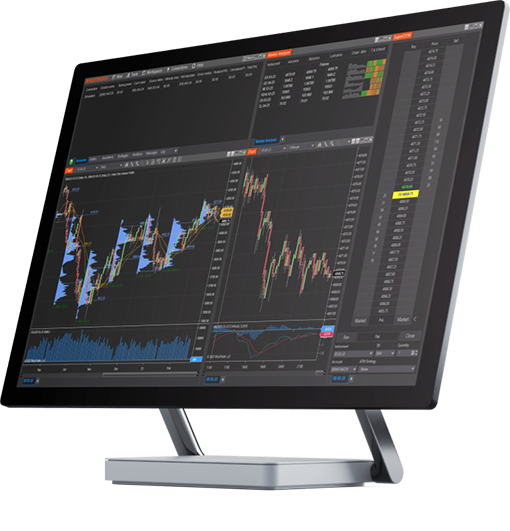
Market Replay — called Playback inside NinjaTrader Desktop — feeds recorded historical market data back through the platform. Charts, indicators and order-entry windows respond as the historical session unfolds.
This makes it possible to practise outside normal market hours, replay a difficult session, test an entry repeatedly or accelerate slower parts of the trading day.
Compress market experience without rushing the decisions
Replay can move through historical data faster than real time, but the purpose is not to click through hundreds of trades quickly.
Use it to rehearse one defined setup, pause after decisions, record screenshots and review whether the trade met the written rules.
What Market Replay is particularly good for
- practising a strategy after work or at weekends;
- reviewing a high-volatility session;
- studying the open, a scheduled economic release or a specific time window;
- rehearsing bracket orders and trade management;
- testing whether an indicator or Renko setup behaves as expected;
- repeating the same market condition until the execution routine becomes familiar.
What can go wrong with replay
Replay becomes less useful when the trader remembers the outcome, skips dull sessions, selects only clean examples or changes the rules while watching the chart. That introduces hindsight and selection bias.
NinjaTrader’s dedicated Market Replay data preserves the sequence of recorded Level I and Level II information. Historical tick playback can also be used, but it is not identical to dedicated replay data and may not include market depth.
Keep the test blind where possible
Pick the instrument and date before opening the chart. Hide the later part of the session. Write the rules first. Then trade what appears rather than selecting a day because you already know it contained a perfect move.
Historical backtesting versus replay
Backtesting is not the same as replay. A backtest applies defined rules to historical data and produces a sample of trades. Replay asks whether you can recognise and execute the process as the market unfolds.
| Question | Backtesting | Market Replay | Live simulation |
|---|---|---|---|
| Does the rule set show historical expectancy? | Best method | Limited sample | Slow to establish |
| Can I recognise the setup in sequence? | Not directly | Very useful | Very useful |
| Can I practise order entry? | No | Yes | Yes |
| Is there hindsight risk? | High if over-optimised | High if outcome is known | Low |
| Does it recreate real financial pressure? | No | No | No |
A robust process uses these methods together rather than choosing one and pretending it proves everything.
A six-stage futures practice plan
The fastest route is not to jump straight into simulated trading and take as many trades as possible. The fastest route is to remove one source of uncertainty at each stage.
Platform control
Learn contracts, order types, stops, targets, position display and emergency exit procedures.
One setup
Define one entry, one invalidation rule, one stop method and one exit process.
Market Replay
Practise the setup across different sessions without changing the rules after every loss.
Live simulation
Execute prospectively in the real-time market using the intended trading window.
Review and evidence
Record screenshots, rule compliance, errors, results and the reason for every rejection.
Smallest live size
Only after process stability, consider the smallest suitable contract with predefined loss limits.
What should you measure in simulated trading?
Profit and loss matters eventually, but it is a poor first measure. A practice account should also tell you whether the process is becoming stable.
Also track:
- number of valid opportunities;
- number of valid trades missed;
- number of trades taken without a valid setup;
- average planned risk versus actual simulated loss;
- results by market, time of day and setup type;
- whether the stop or target was changed outside the rules;
- whether daily and weekly loss limits were respected.
The most useful statistic at the beginning
Track the percentage of trades executed exactly according to the written plan. A 90% rule-compliance rate with modest results is more promising than a large simulated profit created through inconsistent decisions.
Common simulated-trading mistakes
Trading ten simulated contracts when the live account could sensibly support one teaches the wrong emotional and risk scale.
Constant resets hide drawdown, losing sequences and the consequences of poor discipline.
The objective is to practise a defined strategy, not prove that hindsight can find trades.
Small-target strategies can look attractive until commissions, fees and realistic slippage are included.
Constant rule changes prevent a meaningful sample and make every result impossible to interpret.
A short profitable run may be luck. Process consistency and behaviour under drawdown matter more.
Understand the market before practising the platform
Start with the contract mechanics, platforms, leverage and risk foundations before trying to produce results in simulation.
When is a trader ready to consider going live?
There is no perfect threshold, but “I made money in demo this week” is not evidence of readiness.
Before considering live capital, I would want to see:
- a written strategy that can be explained without looking at a chart;
- a meaningful sample across different conditions;
- stable position sizing;
- consistent use of stops and daily loss limits;
- few or no operational errors;
- evidence that costs and slippage have been considered;
- the ability to sit out when there is no valid trade;
- a plan to begin with the smallest sensible contract size.
Live trading is another test stage
Going live does not mean the development process is complete. It tests whether the rules, execution and behaviour survive when the outcome has financial consequences. Start small enough that you can still observe and learn.
Simulation should make you more precise, not more confident
The purpose of practice is not to convince yourself that trading is easy. It is to expose weak rules, operational mistakes and behaviour that would become expensive in a live account.
I would rather see 50 carefully recorded simulated trades in one setup than 500 random trades across six markets. The first sample can tell you something. The second usually tells you only that the trader likes clicking.
Use backtesting to test the idea, replay to rehearse it, live simulation to execute it prospectively and the smallest live size to test behaviour. Used properly, futures trading simulation should produce evidence of process consistency rather than false confidence. Each stage has a job. Do not ask one stage to prove what it cannot prove.
Practise on NinjaTrader and claim the $200 Renko Trading Starter Pack
Start through Stephen Hoad’s tracked route, register as a new NinjaTrader user and log into NinjaTrader Web, Mobile or Desktop. NinjaTrader gives you a practical route into futures trading simulation before live funding. No funding or live trade is required for this bonus route. After successful verification, you can claim the complete Starter Pack.
New NinjaTrader users only. Registration must begin through the tracked route and you must log into a NinjaTrader platform. Bonus delivery is subject to successful tracking and verification.
Futures simulation frequently asked questions
Is simulated futures trading free?
Platform terms vary. NinjaTrader currently provides simulated trading access as part of its platform route, although live data, exchange data or specific features may have separate requirements. Check current official terms before registering.
What is the difference between paper trading and simulation?
The terms are often used interchangeably. In practice, platform simulation usually means hypothetical orders processed by a simulation engine using live or historical market data.
What is the difference between simulation and Market Replay?
Live simulation uses the market as it is moving now. Market Replay uses recorded historical data and can be paused, accelerated or repeated.
Does NinjaTrader have Market Replay?
Yes. NinjaTrader Desktop includes Playback functionality for Market Replay and historical data. Dedicated replay data can preserve the recorded sequence of Level I and Level II information.
Are simulated fills realistic?
They can be useful but are still hypothetical. Real fills can differ because of queue position, liquidity, latency, slippage, rapid price movement and order-routing conditions.
How long should I trade in simulation?
Time alone is not the correct measure. Continue until there is a meaningful sample, stable rule compliance, controlled drawdown and very few execution errors. A trader taking two setups per week needs longer than someone testing several valid opportunities per day.
Should profitable simulation lead straight to a funded account?
No. Review how the profit was produced, whether the rules were followed, whether costs were realistic and whether the sample covers different conditions. If live trading is considered, begin with the smallest suitable exposure.
NinjaTrader simulation and Playback references were checked against NinjaTrader’s official simulator, platform and Desktop help information in July 2026. Platform features and terms can change, so current details should be confirmed directly with NinjaTrader.
 English